Local Government change is coming
Which option do you prefer?
Submissions have closed and a proposal has been submitted
Thank you to everyone who made submissions. Consultation closed on 30 June 2026 and Council has reviewed the feedback.
- A one-page summary of the consultation is here.
- A summary of the feedback is here.
- A list of the submissions is here.
On 4 August 2026, Council agreed to join Hauraki and Thames-Coromandel district councils in putting forward a proposal to Government for a new Waihou–Piako–Hauraki-Coromandel unitary authority.
- View the 4 August extraordinary council meeting here.
The deadline was 9 August 2026 to submit a proposal to central government.
- Read the cover letter that accompanied the Head Start proposal here.
- Read the Head Start proposal here.
We expect feedback from central government in September 2026.
Public information sessions
Public information sessions were held across the district on 22, 24 & 25 June.
If you were unable to make a session you can watch the recording of the Te Aroha presentation (11 minutes) here.
Change is coming to how councils work.
Central government is moving fast on local government reform.
It wants fewer councils and has made it clear that regional councils, like Waikato Regional Council, will not continue in their current form after 2028.
City and district councils, like us, have until 9 August 2026 to respond with a proposal for how local government could be reorganised. If we don’t, central government will decide for us.
This matters. It will affect who makes decisions, how our communities are represented, and how services are delivered.
We’ve been given a very short timeframe. So we are focusing on the options that are most likely to meet the Government’s criteria.
But we also want to be clear about what is at stake for Matamata-Piako.
For us, the key issues are local voice, and local decision making, and the risk of our ratepayers carrying costs that do not reflect our district
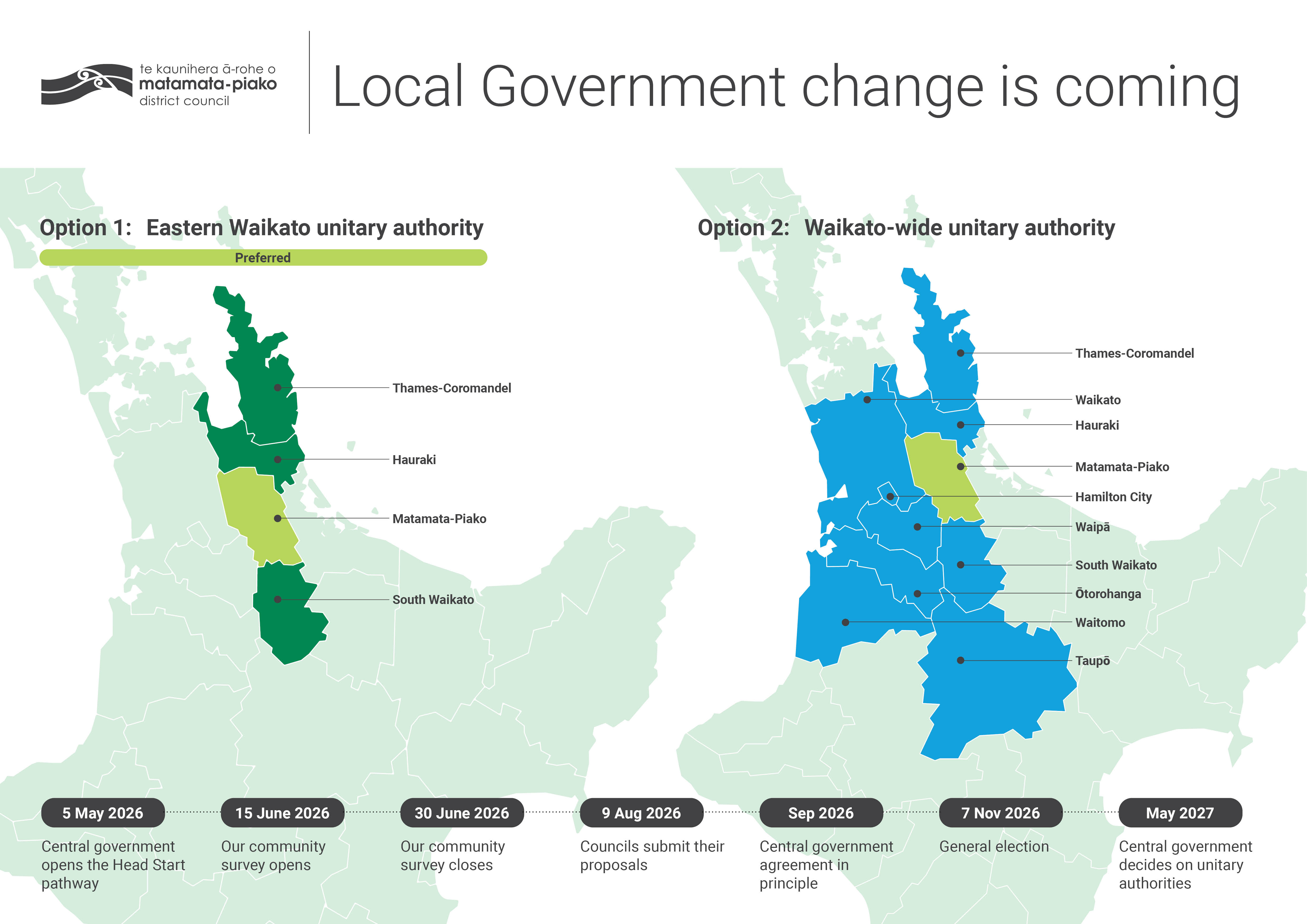
Option one: Eastern Waikato unitary authority – preferred
A smaller unitary authority that could be made up of Matamata-Piako and any or all of the following neighbouring districts: Hauraki, South Waikato, and Thames-Coromandel.
These are areas like ours, with rural and provincial communities and shared interests.
We already work together.
We work with Hauraki and South Waikato on civil defence. We have partnered with Hauraki and Thames-Coromandel to get better outcomes for services like kerbside collection. We also work across shared river catchments like the Waihou and Piako, and into the Hauraki Gulf.
This option builds on the way we already work together.
It allows shared services without giving up local voice or elected representation. It keeps decision making closer to our communities while still delivering the benefits of working together.
At this stage, this is our preferred option.
Our preference is to also keep decision making close to our communities, with our own Mayor and elected members. This is to maintain a strong local voice, representation, and decision making.
Option two: Waikato-wide unitary authority
A single council covering the whole Waikato region, including Hamilton City and other districts.
This would mean one council and potentially one mayor for the whole region.
The main argument for this model is scale. In theory, it could support region-wide planning, shared services, and stronger organisational capability.
But the trade-offs are significant.
At this scale, local voice is at risk. Decisions would be made further away from our communities, and large urban centres could outweigh the needs of smaller rural districts like ours.
There is no clear evidence a model of this scale would deliver the efficiencies often expected.
Our position
We are in a difficult position. We’d prefer to stay as we are. But that is not an option.
We have been given a short timeframe and a clear direction from Government. If we do not put forward an option, we risk being included in a structure that does not represent our community.
So we are trying to steer the best possible outcome for Matamata-Piako.
At this stage, we think Eastern Waikato is the best way to:
- keep decisions closer to home
- protect local voice and representation
- keep working with councils that are similar to ours and we already work well with
- reflect shared catchments, communities of interest, and common goals
This is an important discussion. We want to make sure we hear clearly from you, before we decide which proposal to put forward to Central Government.
Neighbouring councils
You may also be interested in the proposals our neighbouring councils are consulting on:
Thames-Coromandel District Council
Hauraki District Council
South Waikato District Council
Waipa District Council
Waikato District Council
Hamilton City Council
Waipā District Council
Ōtorohanga District Council
Waitomo District Council
Taupō District Council
Central government opens the Head Start pathway
5 May 2026
15 June 2026
Our community survey opens
Our community survey closes
30 June 2026
9 August 2026
Councils submit their proposals
Central government agreement in principle
September 2026
7 November 2026
General election
Central government decides on unitary authorities
May 2027
Frequently Asked Questions
Central government is changing how local government is structured across New Zealand. It wants fewer councils, and it's asking groups of councils to consider joining together to form larger councils that do both local and regional work.